


A pitch deck is the first impression most investors will have of your business. Done right, it could land you the funding to scale to new heights.
The best pitch decks are concise, well organized and easy on the eye. They convey information through graphics, give investors the information they need, and leave them interested and wanting to learn more. Remember that many investors will read your deck without you in the room, often in just a few minutes, so it has to tell the story on its own.
To make it easier, we’ve put together a free, downloadable pitch deck template you can fill in with your own details (see the end of this post).
What great pitch decks include
Here’s the slide by slide structure we recommend. It follows the order used by Y Combinator’s seed deck and Sequoia’s classic outline, so investors find what they expect, where they expect it. Your strongest evidence comes early, because many investors spend only a few minutes on a deck.
1. Title and one line summary
Your company name, logo and a single sentence that says what you do. If you have a standout metric, such as “$1.2M ARR, growing 20% month over month,” put it here too.
2. The problem
Who has the problem, how often they face it, and what it costs them today in time, money or risk. Use a real customer example or a striking data point. The bigger and more frequent the problem, the better.
3. The solution
Your product or service and how it solves the problem, in as few words as possible. Show it: a screenshot, product photo or short demo is far more convincing than a description.
4. Traction
The evidence that your business is working, placed right after the solution so it lands early. Depending on your stage, include:
- Revenue, including month-over-month (MoM) or year-over-year (YoY) growth
- Monthly active users and engagement
- User retention and churn (and resurrection, if relevant)
- Notable customers, pilots or partnerships
- Key milestones achieved so far
Show trends over time with simple charts rather than single numbers, and add a line of context beside each chart. Pre-revenue? Show leading indicators: pilots, LOIs, waitlist growth or usage. Deep tech? Show technical milestones: IP and paid pilots.
5. Insight: why we win
What do you know that others don’t? This is your unique insight into the market, customer or technology, and the reason your approach works when others haven’t. It’s also where you explain your moat: proprietary data, IP, network effects or a distribution advantage.
6. Why now
What has changed (technology, regulation, cost curves or customer behavior) that makes this possible or urgent today? A strong “why now” explains why this opportunity didn’t exist five years ago.
7. Market size
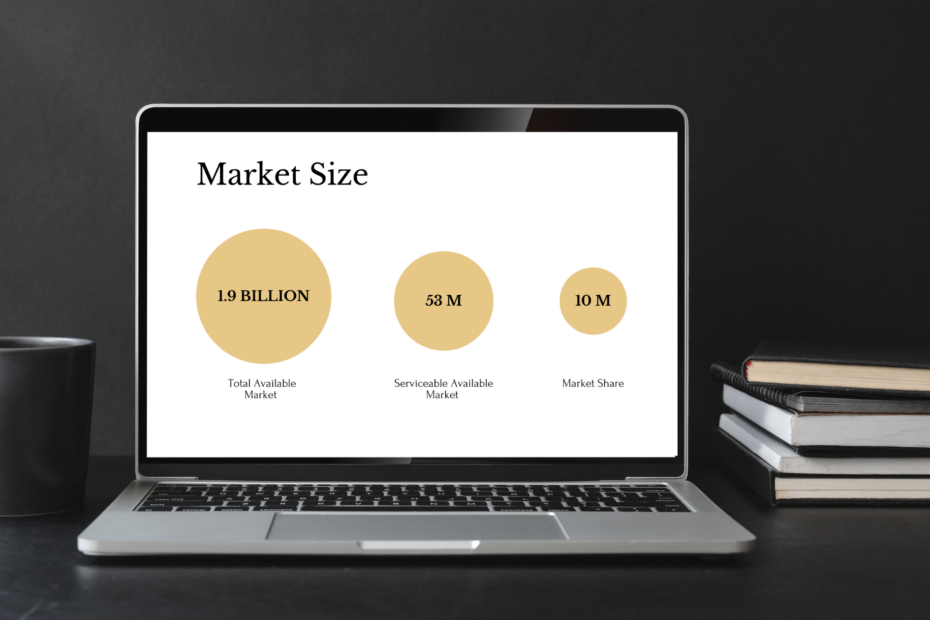
Your addressable market, built bottom-up: the number of target customers multiplied by what each would pay. Show TAM, SAM and SOM if helpful, but focus on a credible path to a large market rather than one very big top-down number.
8. Business model
How you make money: pricing, contract size, and key unit economics such as gross margin, CAC and payback period. Pre-revenue? Show your planned pricing and the evidence behind it.
9. Competition
Show both direct and indirect competitors, honestly. A bubble quadrant chart works well: plot competitors on two axes that matter in your market, size each bubble by revenue or valuation, color-code direct vs. indirect players, and show where you fit. Never claim you have no competition, and don’t talk badly about competitors.
10. Go-to-market strategy
How you will reach and win customers: your first target segment, channels, sales motion and what’s working so far.
11. Founding team
Focus on the founders: each person’s name, position, education, relevant experience and the skills that give the startup a competitive advantage. Make your founder-market fit clear: why are you the team to win this? Note any key hires you plan to make. Advisors belong in the appendix, not on this slide.
12. The ask
The details of the round: how much you’re raising, the instrument (SAFE, convertible note or priced round), the valuation or cap if set, and how much is already committed. Show what the money will go toward, the milestones it will help you reach, how many months of runway it buys, and how it gets you ready for your next round. Add your contact details at the bottom.
Appendix
Keep the main deck short and put supporting detail here: financial projections, cohort and retention charts, customer case studies, technical detail, and advisors. At seed, a full five-year financial model rarely belongs in the main deck. Summarize burn and runway on the ask slide and keep the details ready for diligence.
If you’re building deep tech
For robotics, semiconductors, energy, space, biotech and defense companies, the structure shifts slightly:
- Lead with the technical breakthrough and the proof behind it, right after the problem.
- Replace or supplement traction with technical milestones achieved, your technology readiness level (TRL), IP filed or granted, and paid pilots, LOIs or government contracts.
- Show projected unit economics at scale, such as bill of materials, yield and target gross margin.
- Frame the ask around which technical and commercial risks this round will remove.
Keep it short and simple
Aim for approximately 12 slides plus an appendix, and no more than 15. The fewer the better: if you can get the point across in 10, there’s no need to fill out five more. Put anything extra in the appendix.
- One idea per slide, with a headline that states the takeaway (“Revenue grew 3x in six months,” not “Traction”).
- Visuals over text. Use charts, diagrams and product images instead of paragraphs.
- Readable fonts. If you have to shrink the text to make it fit, there’s too much on the slide.
- Consistent design. Stick to two or three colors and one or two fonts.
Also keep in mind that your pitch to an investor is not the same as your pitch to customers. Investors want to understand the size of the opportunity, the business model and why you’ll win. Avoid technical jargon, keep it simple, and skip fluffy marketing language.
Before you send it
- Check that every number is current and consistent across slides and your financial model.
- Delete any leftover template or “demo” content.
- Send it as a PDF or “view only” link with a clear file name, such as “CompanyName_Seed_Deck.pdf”.
- Ask someone outside your company to read it cold. If they can’t explain your business back to you in a sentence, keep refining.
For the most common pitfalls to avoid, read our post on the Top 5 Mistakes in Pitch Decks.
Download the free pitch deck template
Our free, editable PowerPoint template follows the structure above, with guidance on every slide. It opens in PowerPoint, Keynote and Google Slides. Replace the placeholder text with your own details, delete the guidance notes, and you’ll have a solid first draft ready to refine.