



New Investors Building a Portfolio for Power Law
Venture investing is very different from investing in public markets. Startups are illiquid, information is limited, and outcomes can be highly uneven. A small number of exceptional companies may drive a large share of overall returns. In a typical 25 company portfolio, the top 4% of companies can drive roughly 60% of total value returned.
For new investors, that makes portfolio construction, diversification, investment structure, and diligence especially important.
Think in Portfolios, Not Individual Deals
A compelling startup can still fail.
Markets change, products miss, competition emerges, and financing dries up. Even strong founders can encounter challenges that are difficult to predict at the time of investment.
That is why venture investing should generally be approached as a portfolio strategy, rather than a collection of isolated bets.
The goal is to build enough exposure to potential outliers while avoiding excessive dependence on any single company, sector, or point in time.
Position sizing matters too. Investors may choose to spread initial capital across multiple opportunities while reserving additional capital for companies that show growth.
The objective is not simply to own more startups, it is to construct a diversified portfolio intentionally.
Funds vs. SPVs
Two common ways to access venture investments are through venture funds and special purpose vehicles (SPVs).
Venture Funds
A venture fund gives an investor exposure to a portfolio selected and managed by the General Partner.
Funds can be useful for investors seeking:
- Built-in diversification
- Professional sourcing and diligence
- Exposure across multiple companies, typically with less capital required than going direct
The tradeoff is that investors do not select each underlying investment, and it is more hands off.
SPVs
An SPV is typically created for one specific company or transaction.
This gives investors greater control over where they allocate capital and can be useful for companies where they have particularly high conviction.
SPVs, however, require investors to evaluate opportunities individually and manage their own portfolio concentration.
A simple way to think about the two:
Funds provide the diversification and foundation, while SPVs provide selective exposure.
For many investors, combining both can create a balanced approach where they have a diversified exposure in the fund and chose to invest in SPVs for companies not on thesis for the fund, or to increase exposure to a specific company in the fund.
Diversification Goes Beyond Company Count
Owning many startups does not necessarily mean a portfolio is diversified.
Twenty companies can still be highly concentrated if they are all in the same sector, stage, geography, or point in time within a certain economic cycle.
We generally think about venture diversification across four dimensions:
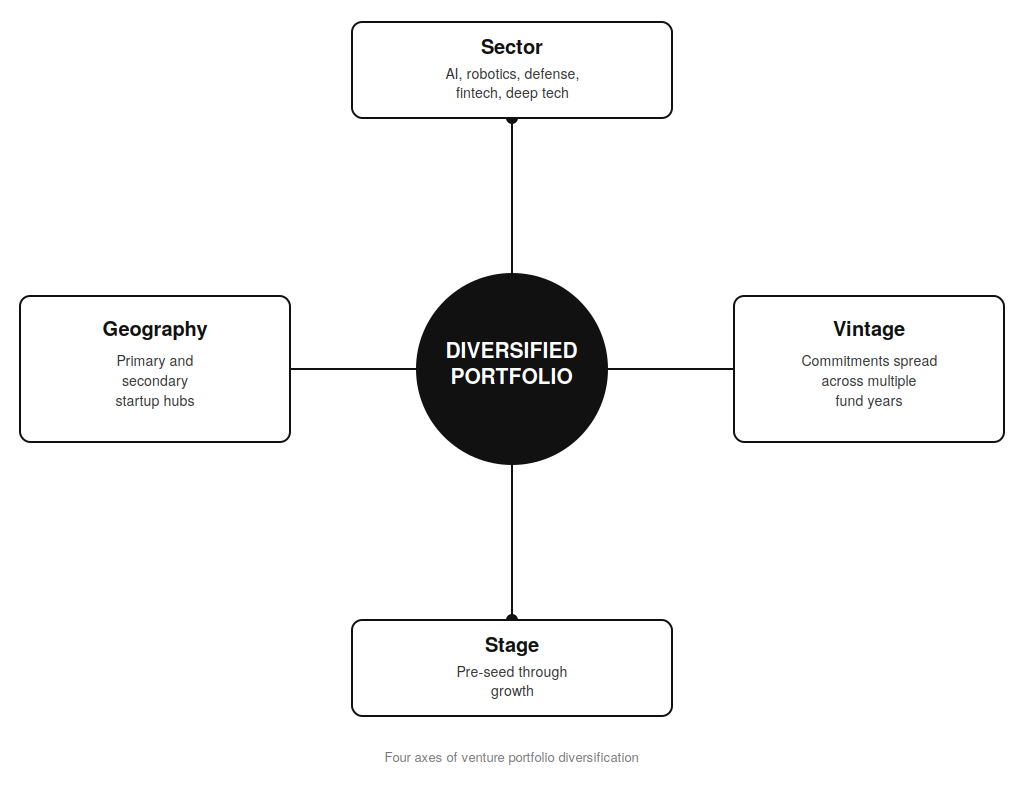
Sector
Exposure across areas such as AI, robotics, semiconductors, energy, software, and deep tech can reduce dependence on a single technology cycle.
Stage
Pre-seed, seed, Series A, and growth stage companies carry different risk/reward profiles, levels of uncertainty, valuation, and operating evidence.
Geography
Innovation is increasingly global. Exposure across different startup ecosystems can provide access to different markets, talent pools, and technological strengths.
Vintage
Capital deployed at the top of a valuation cycle faces a different entry price environment than capital deployed after a correction. Spreading commitments across multiple vintage years, rather than deploying a full allocation into a single year, reduces exposure to any one market cycle.
The number of companies matters, but what those companies are exposed to matters more.
Diligence: Understand What You Are Underwriting
Early stage investing will always involve more uncertainty.
The purpose of diligence is not to eliminate it, but to understand what needs to be true for the investment to succeed.
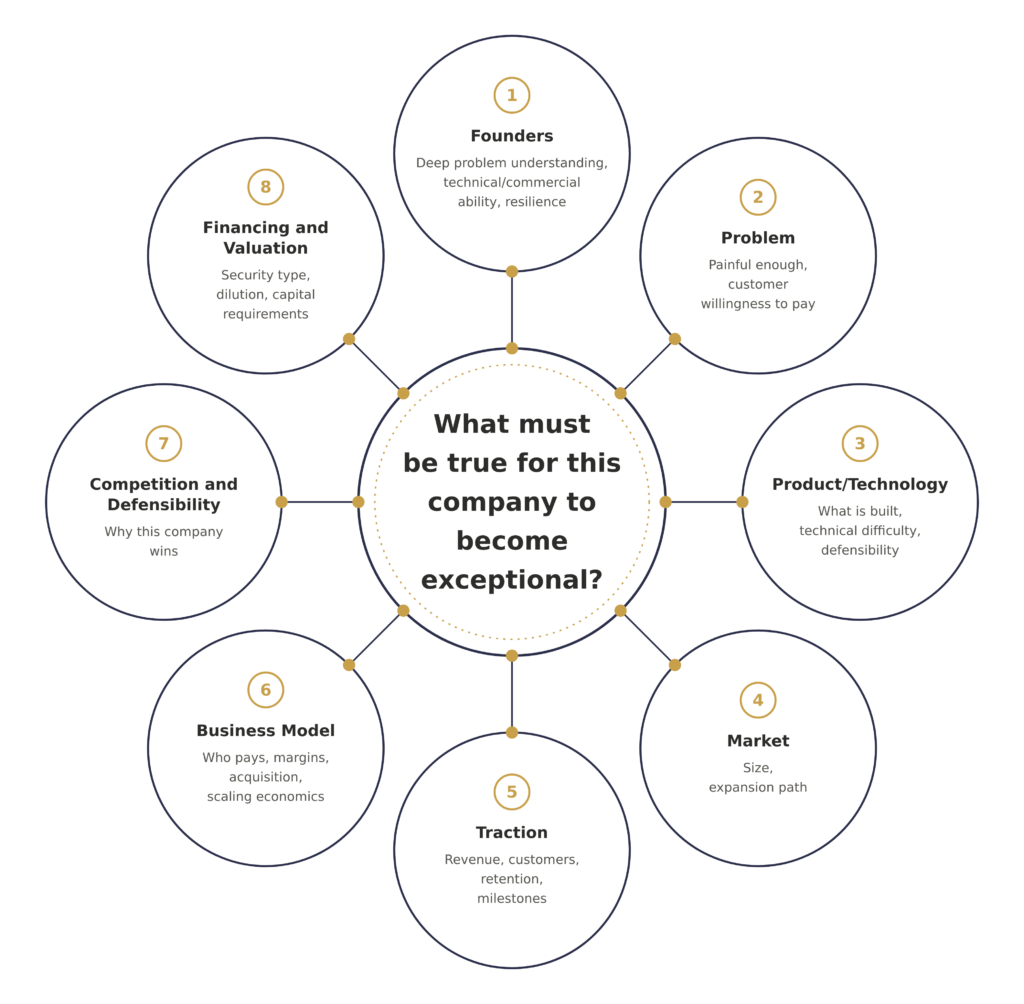
Key areas to evaluate include:
- Team: Here you are looking for founder market fit. Are they uniquely equipped to solve this problem? Do they have the educational background, work experience, and network in this sector?
- Problem: Is it important enough that customers will pay for a solution?
- Product & Technology: What is differentiated or difficult to replicate?
- Market: How large could the opportunity become?
- Traction: What evidence suggests customers want the product? Revenue, LOIs or MOUs?
- Business Model: How does the company make money and scale?
- Competition: Who are also playing in this space (direct/indirect)? Why can this company win? Compare both public and private comps.
- Financing & Valuation: Are the terms and capital requirements reasonable? Will this capital help them achieve the necessary milestones to hit the next round?
For deep tech companies, technical diligence and IP becomes particularly important. A scientific breakthrough is not necessarily the same thing as a scalable business.
Build the Strategy Before the Portfolio
Before evaluating individual deals or funds, investors should consider a few basic questions:
- How much capital are you comfortable allocating to illiquid investments?
- How many companies do you want exposure to? Which sectors and stages fit your strategy?
- How much should any single investment represent?
- Will you invest primarily through funds, SPVs, or a combination?
Establishing those parameters before seeing attractive opportunities can help create more disciplined decision making.
Venture Investing Is About Intentional Risk
Risk is inherent to venture capital. The goal is not to eliminate it. The goal is to take risk deliberately, with thoughtful portfolio construction, diversification, diligence, and appropriate position sizing.
Want to go deeper? Download our full guide to venture portfolio construction, funds vs. SPVs, diversification, and startup diligence.
This article is for educational and informational purposes only and does not constitute investment, legal, tax, or financial advice. Private investments involve significant risk, including the possible loss of invested capital, and are generally illiquid.