


The global space economy is projected to grow from $630 billion in 2023 to $1.8 trillion by 2035, about 9% a year and roughly twice the pace of global GDP, according to the World Economic Forum and McKinsey. That is $1.2 trillion of new annual value created in about a decade.
The headlines are rockets and moon landings. The money is somewhere quieter. Space is turning into infrastructure: a layer of connectivity, positioning, timing and imagery that other industries build on, the way they once built on electricity, the internet and the cloud.
Infrastructure layers create two kinds of winners: the companies that build the layer, and the far larger set of companies that only become possible once it exists. Our view at Ventioneers is that the second group is where most of the next decade’s venture returns in space will come from, spanning compute, energy, manufacturing, resources, communications and defense.
The money is in the reach, not the rockets
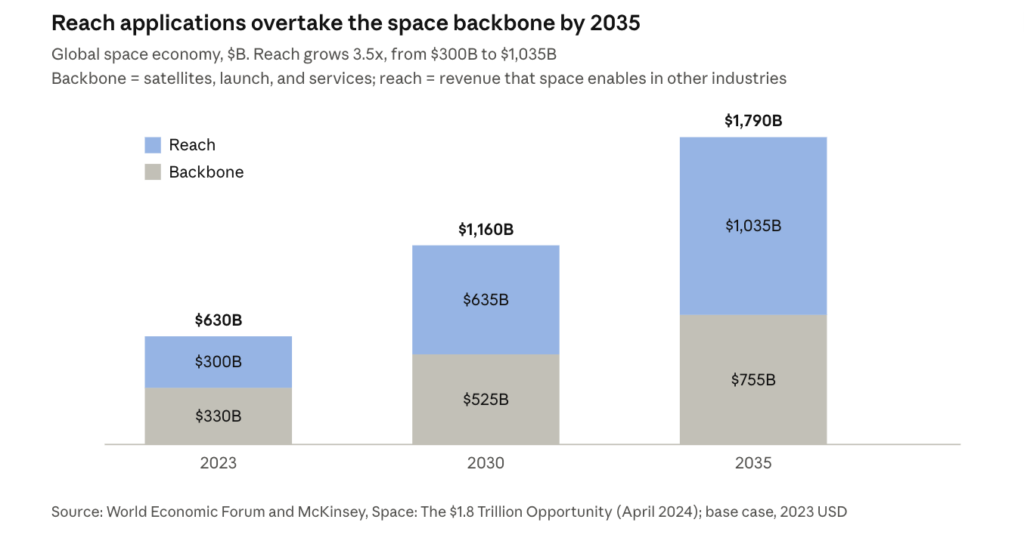
The WEF splits the space economy in two. The backbone is satellites, launch and services sold directly by space companies. The reach is revenue that space makes possible elsewhere: ride hailing that runs on GPS, food delivery, parcel tracking, satellite connected e-commerce.
Reach is projected to grow about 11% a year against 7% for the backbone, becoming nearly 60% of the space economy by 2035. Five industries (supply chain and transport, food and beverage, defense, retail and consumer goods, and digital communications) drive over 60% of the increase. Most of the value accrues to companies that would never call themselves space companies.
The customer has changed
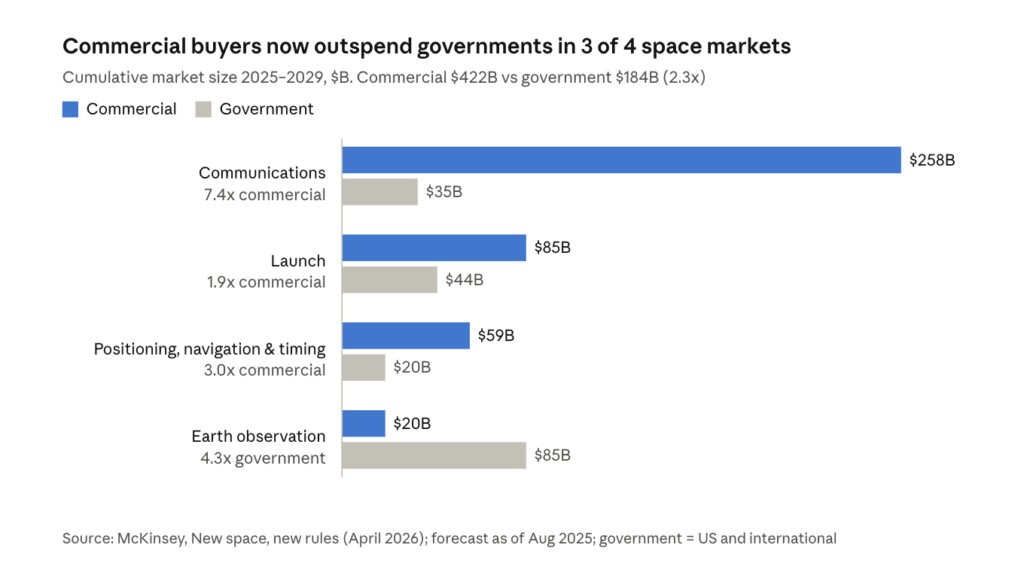
For 60 years, governments were space’s anchor buyer. McKinsey now expects commercial markets to outspend governments by two to one or more across communications, launch and navigation in the second half of this decade. Earth observation is the exception, where government spend is about four times commercial.
This is the change that makes space venture investable. Commercial customers buy faster, buy repeatedly, and set the pace of innovation. Government remains a valuable anchor customer, especially in defense, but a startup no longer has to live or die by a single procurement cycle.
The cost curve is the engine
Launch costs have fallen about 10 fold over 20 years, and satellites launched per year grew more than 50% annually from 2019 to 2023, per the WEF. Reusable heavy lift vehicles are expected to cut cost per kilogram by another 40% between 2023 and 2035. Deloitte notes a nanosatellite can now reach low Earth orbit for under $100,000, against tens or hundreds of millions for a traditional satellite.
Cheaper access changes what is worth putting in orbit. The clearest new example is compute. Bain estimates a 100 MW orbital data center today costs roughly 50% more per kilowatt than a terrestrial one, mostly because of launch. At about $600/kg on Falcon 9, launch alone exceeds the cost of the compute hardware; at $50 – 100/kg, orbital economics could favour space by the mid – 2030s.
The pull comes from the ground. Bain’s 2026 Technology Report puts hyperscaler capex near $780 billion this year, with single AI campuses heading toward 9 GW by 2030. When grid interconnects and permits become the bottleneck, orbit, with continuous solar power and radiative cooling, starts to look like a real alternative for inference workloads.
Where growth outruns the market
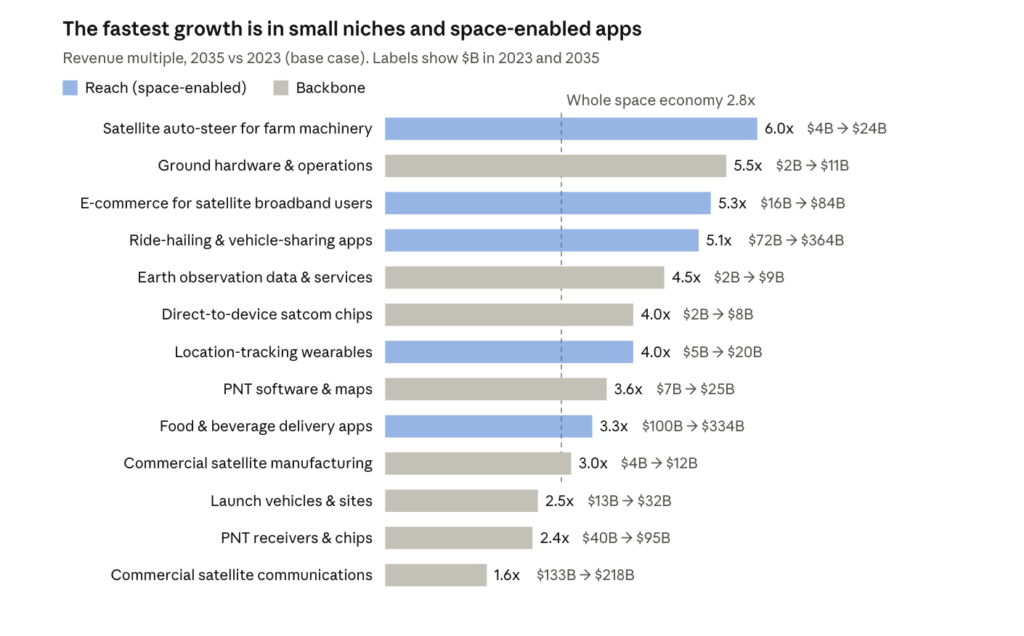
The biggest dollar pools are mature: satellite communications grows only 1.6x by 2035 as satellite TV declines. The fastest growth sits in segments that are small today, such as ground operations, Earth observation analytics and direct to device chips, and in apps that ride on free space signals. That is where early stage capital can still shape a category.
Where Ventioneers is looking
We back companies with a defensible moat and a credible path to $1B+. In space, that points us to five themes:
- Orbital and edge compute. Processing data in orbit, and eventually running AI inference there, as terrestrial power becomes the binding constraint on AI.
- Space data, made usable. Earth observation value is shifting from raw imagery to fusion, analytics and vertical products for insurance, energy, agriculture and finance. Proprietary data that compounds is the moat.
- Direct to device and resilient connectivity. Satellite chips in phones and IoT, and the software that blends satellite and terrestrial networks.
- Defense and dual use. Space sensing, secure communications and space domain awareness, where state budgets remain the anchor customer.
- In orbit infrastructure. Servicing, refuelling, debris removal and space insurance: the picks and shovels of a crowded orbit.
We are less interested in businesses whose only edge is a launch slot or a single government contract. The best space companies we see sell to non-space customers, own a data or distribution advantage, and get stronger as launch costs fall rather than being commoditised by it.
Download the full report here.
Building in one of these areas? Pitch Us Here!
Sources
- Space: The $1.8 Trillion Opportunity for Global Economic Growth, World Economic Forum with McKinsey, April 2024
- Space: The $1.8 trillion opportunity for global economic growth, McKinsey, April 2024
- New space, new rules: Commercial space markets are taking off, McKinsey, April 2026
- McKinsey and the space sector, McKinsey
- xTech Futures: SpaceTech, Deloitte, 2023 (overview page)
- Orbital Data Centers: Beyond the Grid, Bain, July 2026
- New Innovation Is Required to Fund AI’s $6 Trillion Buildout, Bain Technology Report 2026 (PDF)
This article is for information only and is not an offer to sell or a solicitation to buy any security.