


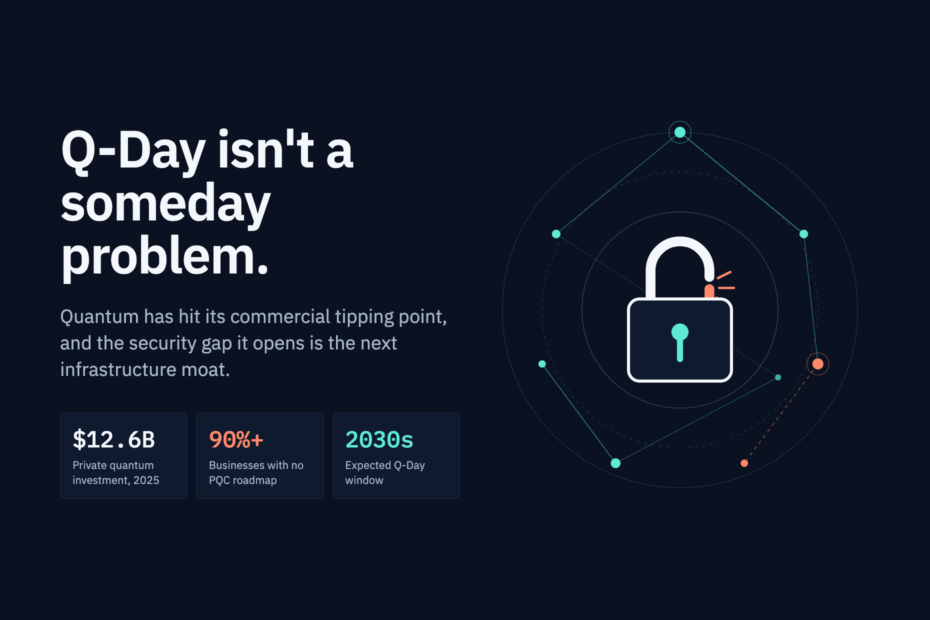
For most, “quantum computing” still sounds like a decade out physics story. But it isn’t. Across the research we’ve tracked: McKinsey, Deloitte, the World Economic Forum, and national quantum strategy bodies, the same signal keeps showing up, quantum has moved from lab curiosity to commercial inflection point, and the cybersecurity implications are arriving faster than most are prepared for.
Here’s what the data is telling us, and why it matters to how we evaluate infrastructure and security opportunities at Ventioneers.
The market is no longer theoretical
Quantum investment didn’t creep up in 2025, it exploded. Private investment in quantum technology start ups reached roughly $12.6B in 2025, more than six times the prior year’s total, and quantum computing companies alone generated over $1B in revenue for the first time.[1] McKinsey’s latest Quantum Technology Monitor estimates quantum computing could unlock $1.3T to $2.7T in economic value by 2035, with the internal quantum technology market (hardware, software, services) reaching $60 – 100 billion in the same window.[1]
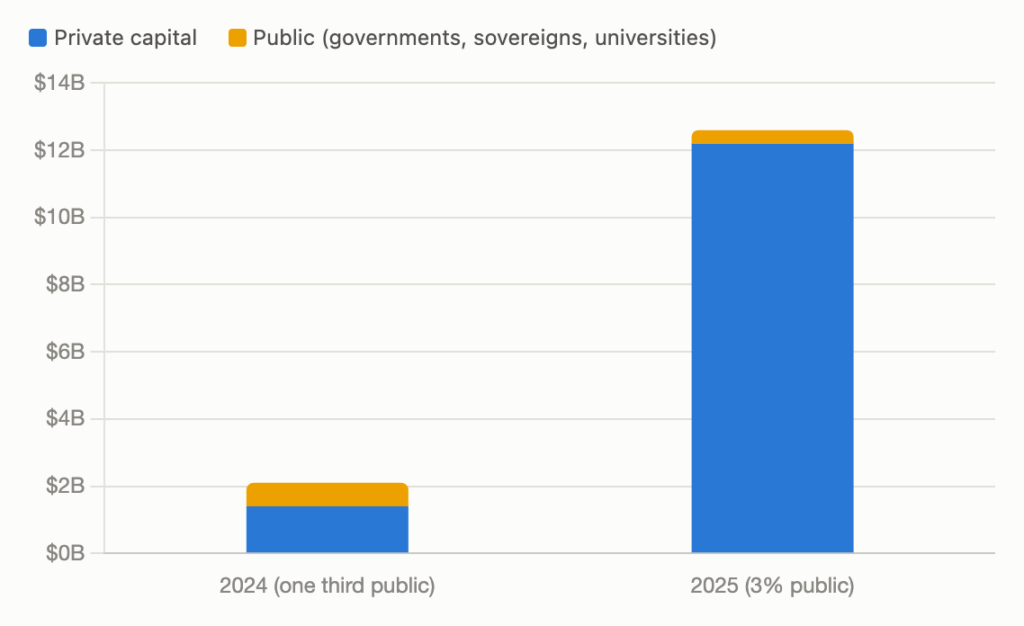
More telling than the dollar figures is who’s writing the checks. In 2024, a third of quantum investment came from public sources: governments, sovereign funds, universities. In 2025, that number fell to just 3%.[1] Capital is shifting decisively to private hands, and over 300 companies, from JPMorgan Chase to Airbus, are now running quantum pilots embedded in real workflows rather than one off research collaborations.[1] That’s the definition of a commercial tipping point.
Q-Day isn’t a someday problem
The flip side of quantum’s promise is quantum’s threat, and this is where our attention sharpens. “Q-Day,” the point at which a sufficiently powerful quantum computer can break the public key cryptography underpinning nearly all digital trust, is widely expected sometime in the 2030s.[2] That sounds distant until you account for “harvest now, decrypt later” attacks: adversaries are already exfiltrating encrypted data today with the explicit intent of decrypting it once quantum capability catches up.[2][4] Anything with a long confidentiality shelf life: health records, trade secrets, IP, financial data, government communications, is exposed right now, not in ten years.[2]
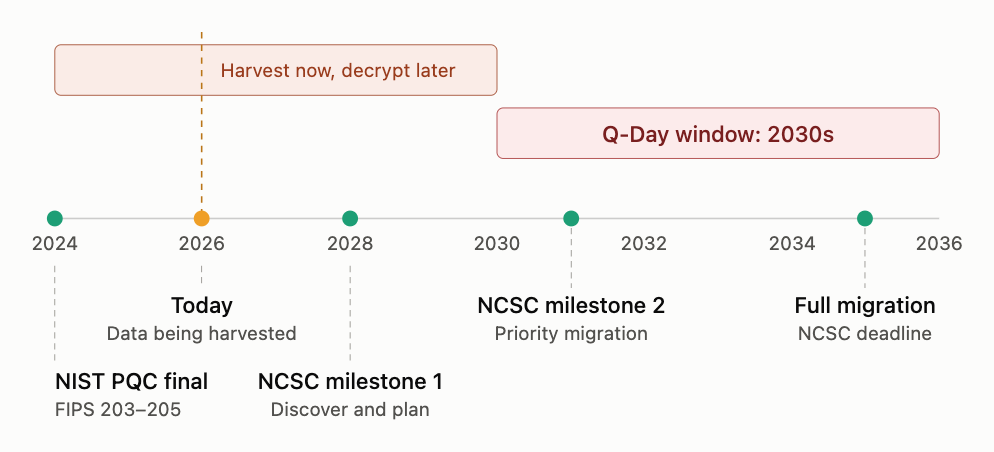
Standards bodies are already moving. NIST has finalized post quantum cryptography (PQC) standards and is urging immediate adoption; the UK’s National Cyber Security Centre has published migration deadlines running out to 2035.[2] And yet, per industry research cited by McKinsey, over 90% of global businesses still have no roadmap for the transition.[2] That gap, between where the threat curve is headed and where enterprise readiness actually sits, is exactly the kind of asymmetry we look for.
Where the real exposure lives
The WEF and Deloitte’s joint research on cryptographic agility frames the problem in a way we find useful for diligence: this isn’t just a “swap the algorithm” exercise.[4] Three structural risks compound:
- Confidentiality decay: data encrypted today may already be harvested for future decryption.[2][4]
- Erosion of digital trust: signatures, certificates, and software update mechanisms all lean on public key cryptography; if that foundation cracks, so does the ability to verify identity and authenticity across the internet.[2]
- Cryptographic debt: most organizations don’t even have a clean inventory of where cryptography lives inside their own stack, let alone a plan to replace it.[2]
That third point is the one that should worry every CISO and excite every investor. Migration to PQC is not a patch, for tightly coupled legacy systems, it can mean full architectural redesign, as the industry’s slow, expensive move off SHA-1 illustrated.[2] The organizations (and vendors) that build crypto agility in now, the ability to swap cryptographic primitives without re-architecting the whole stack, will have a durable advantage over those forced into panic migrations later.[2][4]
Why this matters for our thesis
We invest at the intersection of AI, deep tech, and infrastructure moats: categories where defensibility comes from hard technical barriers, not feature velocity. Quantum safe security is a clean example: it’s not a wrapper, it’s not easily replicated, and it sits directly in the path of a multi trillion dollar, multi decade infrastructure transition that every regulated industry, financial services, healthcare, telecom, defense, will be forced to fund.[1][2]
This is part of why we’re excited about QTi, a quantum communications and network security company in our portfolio building at exactly this junction of quantum computing and applied cybersecurity.
Meet the team behind QTI
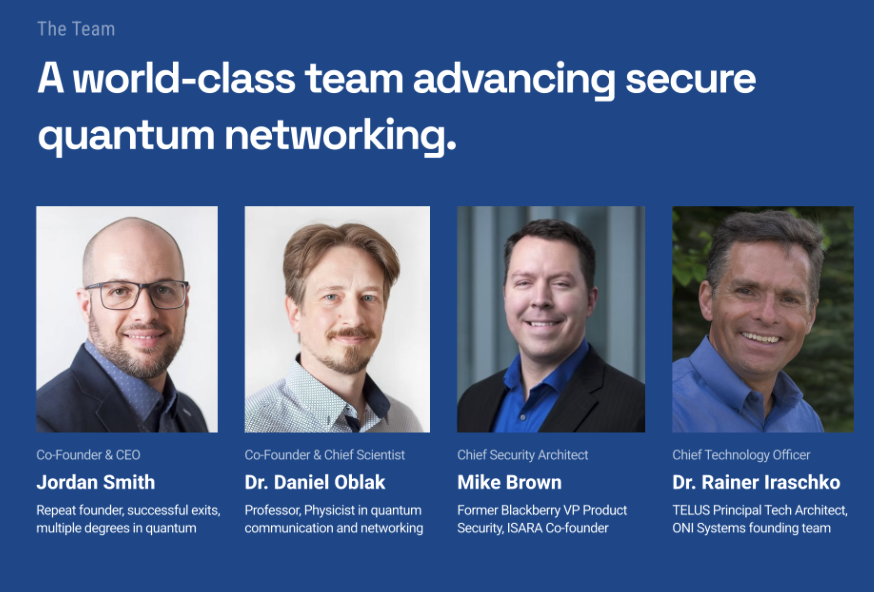
QTi (Quantized Technologies Inc.) was co-founded as a spinout of the University of Calgary’s Institute for Quantum Science and Technology.[5] Jordan Smith, Co-Founder and CEO, brought an entrepreneurial track record built before QTi, including ventures in high performance automotive, crane services, and construction, into a research to market path through UCalgary, where he earned a BComm, BSc, and MSc.[5] Dr. Daniel Oblak, Co-Founder and Chief Scientist, was Smith’s graduate supervisor at UCalgary’s quantum institute and anchors the company’s deep technical bench.[5] As Oblak has put it, the team’s founding insight was that encryption alone isn’t the whole answer: “a secure, large-scale quantum infrastructure is the key to unlocking the next generation of technological advancements.” [5]
That combination, commercial instinct paired with genuine quantum physics depth, is exactly the founder profile we look for in deep tech. It shows up in QTI’s product roadmap: QuSera, a quantum secure encryption platform that combines the company’s patent pending QuEdge entanglement distribution technology with post quantum cryptography to protect today’s classical networks, and a longer horizon bet on commercial quantum repeaters: the hardware needed to extend quantum signals across distance and eventually underpin a functioning quantum internet.[5][6]
As enterprises move from “should we worry about quantum?” to “how fast can we migrate?”, we think companies with real technical depth in PQC, entanglement distribution, and crypto agility, not surface level compliance tooling, are positioned to become category infrastructure, not features that get commoditized.
What we’re watching next
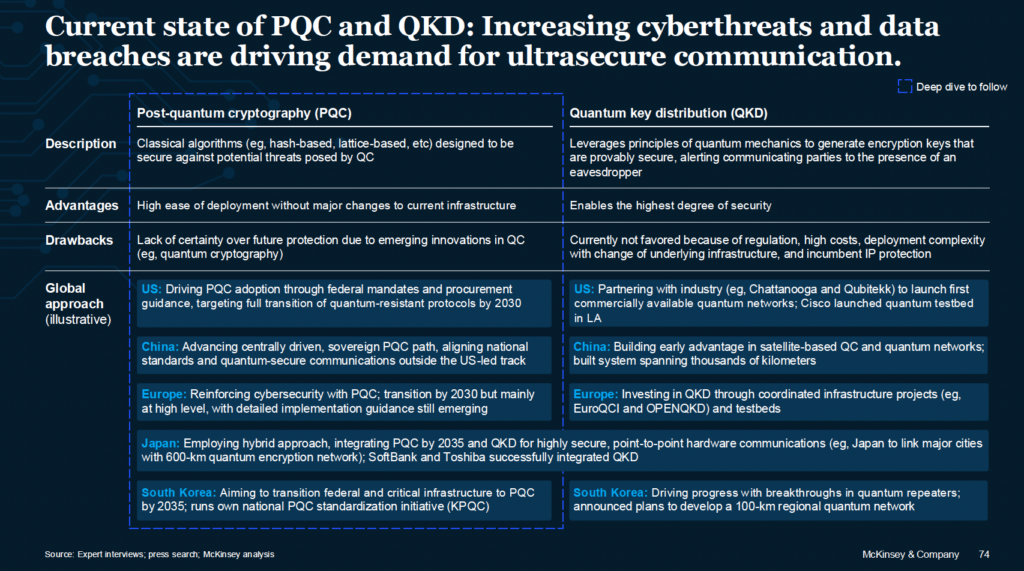
- PQC vertical growth. McKinsey projects the PQC market alone could reach $2.4–3.4B by 2035, with modular connectors and quantum key distribution close behind, meaningful verticals for infrastructure plays, not just research grants.[1]
- Sector specific urgency. Financial services (transaction integrity, long term records) and telecom (fastest growing share of the quantum communications market, from single digits in 2023 to 16 –26% by 2035) are moving first, good hunting ground for enterprise security go-to-market.[2]
- Consolidation signals. 2025 saw real M&A and exit activity in quantum computing (IonQ’s acquisition spree, Xanadu’s SPAC listing), an early sign the category is maturing past pure research plays into scalable, ownable businesses.[1]
- Government posture. National quantum strategies, including Canada’s, are shifting from funding pure research toward workforce development and commercialization support.[3]
References
[1]: McKinsey & Company, “McKinsey Quantum Technology Monitor 2026: A commercial tipping point,” April 28, 2026. https://www.mckinsey.com/capabilities/mckinsey-technology/our-insights/mckinsey-quantum-technology-monitor-2026-a-commercial-tipping-point
[2]: McKinsey & Company, “Quantum is almost here: Are you and your systems ready?,” April 24, 2026. https://www.mckinsey.com/capabilities/risk-and-resilience/our-insights/quantum-is-almost-here-are-you-and-your-systems-ready
[3]: Innovation, Science and Economic Development Canada, “National Quantum Strategy — What We Heard Report,” 2022. https://ised-isde.canada.ca/site/national-quantum-strategy/sites/default/files/attachments/2022/NQSC-What-We-Heard-Report.pdf
[4]: Deloitte Global, “Managing the Quantum Cybersecurity Threat,” in collaboration with the World Economic Forum. https://www.deloitte.com/global/en/services/consulting-risk/research/managing-the-quantum-cybersecurity-threat.html; World Economic Forum, “Transitioning to a Quantum-Secure Economy,” 2022. https://www3.weforum.org/docs/WEF_Transitioning%20to_a_Quantum_Secure_Economy_2022.pdf
[5]: University of Calgary, “UCalgary startup QTi is helping build the quantum internet,” 2025. https://ucalgary.ca/news/ucalgary-startup-qti-helping-build-quantum-internet; Pulse 2.0, “University Of Calgary Spinout Quantized Technologies (QTi) Raising $4 Million,” April 2025. https://pulse2.com/university-of-calgary-spinout-quantized-technologies-qti-raising-4-million/
[6]: Quantized Technologies Inc., company website. https://www.quantizedtech.com/