


How to Evaluate AI Companies
What founders need to prove, and what LPs should understand about AI defensibility.

In short: Revenue proves an AI product is useful. It does not prove the business can keep its customers and its margins as models improve and incumbents catch up.
Using someone else’s model does not always disqualify a company. Calling a business “AI native” does not make it defensible. The questions we care about are simpler: what does the business own, what compounds as it grows, and who ends up capturing the value?
What we mean by a wrapper
A wrapper is a product whose main value comes from packaging someone else’s model. A thin interface can become a valuable company if it turns into the trusted way to get important work done.
The problem is not being a wrapper. The problem is staying easy to copy while the valuation assumes lasting leadership. A prompt, an interface and early revenue can prove usefulness without proving pricing power or loyalty.
An early stage company does not need a finished moat. It needs a credible path to one, and the honesty to separate what is proven from what is planned.
Better models raise the bar for everyone
Each model upgrade can make a startup’s product better. It also makes rival products, and a customer’s own internal build, easier to create. Cheaper model access does not mean cheaper delivery, either: in McKinsey’s 2026 survey, about one in five respondents said AI operating costs, including token costs, had limited how much AI their organization could use (McKinsey 2026).
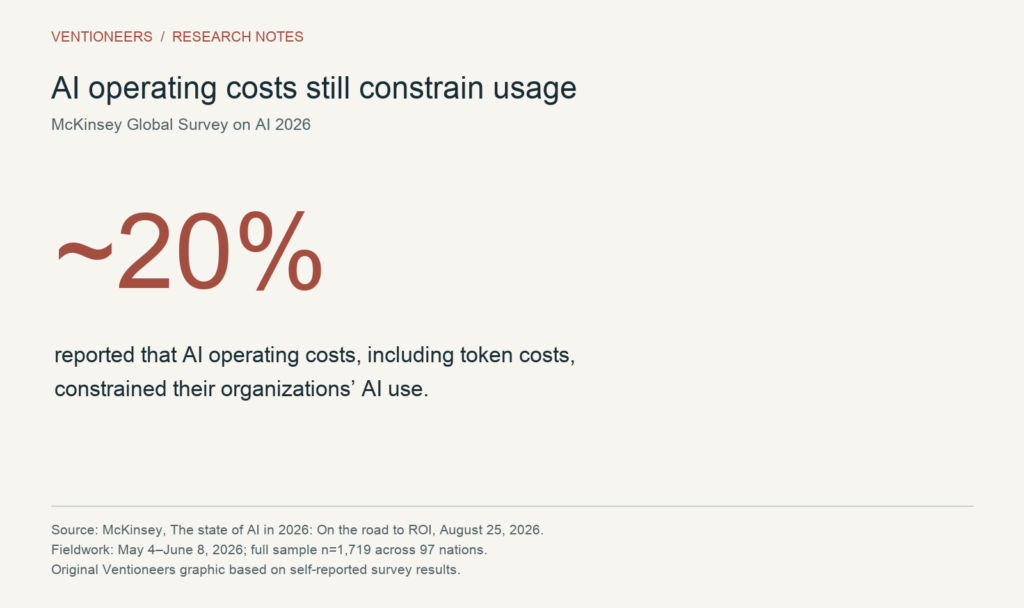
Figure 1. About 20 percent reported AI operating costs constrained usage. Original Ventioneers graphic based on McKinsey 2026. Published August 25, 2026; fieldwork May 4–June 8, 2026.
We ask every AI founder the same question: if competitors could create a similar product tomorrow, why would customers still choose you?
Five credible answers
There are five good answers to that question. Each needs evidence beyond a polished interface.
1. Workflow ownership: become part of how the work gets done
Take two tools for an industrial maintenance team. One summarizes equipment manuals. The other pulls the equipment history, finds the right procedure, drafts the work order, routes it for approval and records the finished repair.
Both may run on the same model. Only the second is woven into how the plant operates. Its advantage comes from handling exceptions, keeping integrations working and supporting the people who sign off on the result. In an operator, that is where the real switching cost lives.
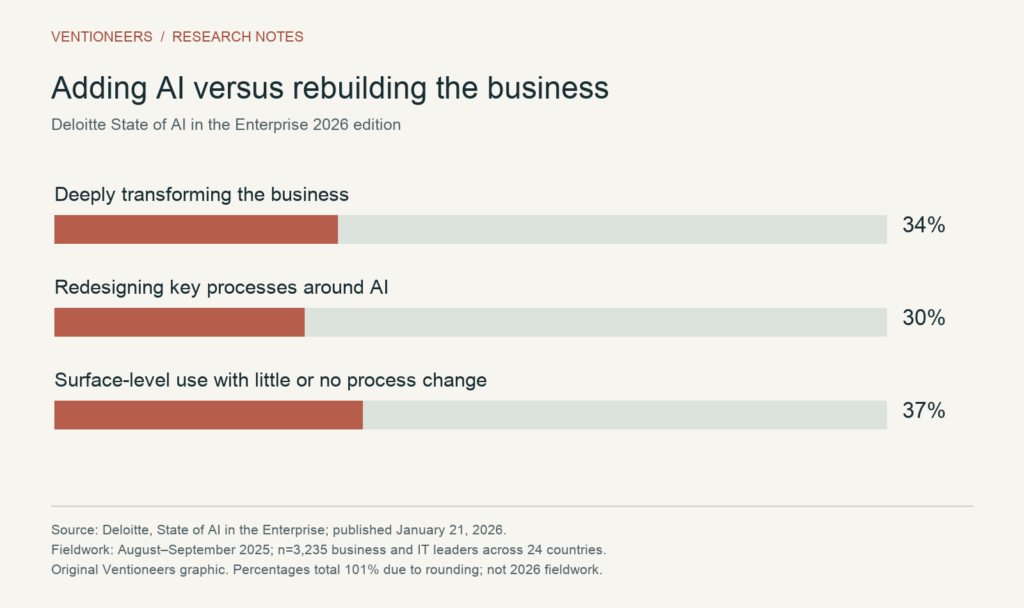
Figure 2. Deloitte reported 34 percent deeply transforming the business, 30 percent redesigning key processes and 37 percent using AI at a surface level. Original Ventioneers graphic based on Deloitte 2026. Published January 21, 2026; fieldwork August–September 2025.
What we look for: recurring use, operational importance and measured customer value. Being integrated is not enough on its own.
2. Distribution: can you reach the buyer again and again?
Distribution can come from industry relationships, embedded partnerships, referrals or a repeatable sales motion built around one buyer. Each successful deployment can become a reference, and references shorten the next sale.
But a marketplace listing is not loyalty, and a partnership press release is not revenue. A channel owned by someone else can change its terms.
What we look for: falling cost to reach qualified buyers, customers introducing you to peers, and someone other than the founder closing deals.
3. Customer data: access is only the beginning
“We have proprietary data” is easy to put on a slide. We ask four questions before we believe it.
| Test | The question | What a strong answer looks like |
| Rights | What do your contracts actually let you do with the data? | Written permission to retain it and improve a shared product, not just to process it for one customer |
| Distinctiveness | Could a competitor get something similar from customers, public sources or data vendors? | Data that exists only because customers use your product |
| Learning value | Does the data show whether the system got it right? | Verified outcomes, not just activity logs |
| Measured improvement | Does it make the product better on new cases? | Before-and-after results on held-out customer tasks |
In the maintenance example, valuable data would link a symptom to the inspection, the repair and the confirmed result. That chain can improve the next recommendation. A pile of chat logs usually cannot.
More data is not always better. It adds noise and cost, and data from one customer often improves only that customer’s deployment. A data advantage exists when permitted access produces an improvement that competitors struggle to copy. Training a proprietary model is one route to that, not the only one.
4. Switching costs: what would replacing you require?
Real switching costs build up through integrations, configured workflows, operating history and trained users. Replacing the product means migrating records, rebuilding approvals, re-testing reliability and retraining people. Those costs are real even when a rival is cheaper.
Still, friction alone is a weak moat. An unhappy customer will eventually pay to leave. The healthy version is a product that keeps delivering value and becomes more useful the more the customer invests in it.
What we look for: renewals, expansion and references. Long contracts alone do not count.
5. Customer outcomes: prove the value after the demo
McKinsey’s 2026 survey shows the gap clearly: 80% of respondents report better personal productivity, but only 37% of respondents attribute any EBIT impact to AI (McKinsey 2026). Feeling faster and earning more are different things.
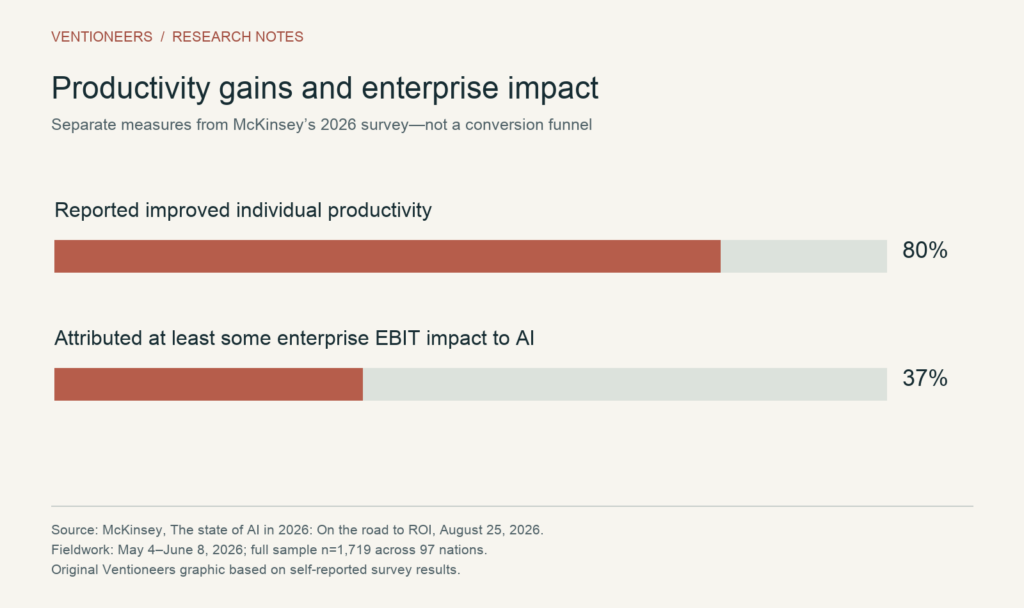
Figure 4. 80 percent reported individual productivity gains and 37 percent attributed at least some enterprise EBIT impact to AI. Original Ventioneers graphic based on McKinsey 2026. Published August 25, 2026; fieldwork May 4–June 8, 2026.
So “hours saved” is only a starting point. We want to know what those hours turned into, after counting the human review, failed attempts, escalations and support it took to get there.
| What founders often claim | What convinces us |
| We automate document review. | Customers finish a defined process faster at an agreed quality level. |
| Users save five hours a week. | The time saved produces a verified operating benefit. |
| The model is highly accurate. | The system meets the task’s requirements, including exceptions and review effort. |
| Customers love the product. | Customers renew, expand and give references. |
Measured value does not make a company impossible to copy. It gives customers a reason to stay while the other advantages develop.
The substitution test
The threat to many AI startups is not another startup. It is the customer building it themselves. In McKinsey’s 2026 survey, 32% of respondents said their organization had decided against buying at least one software product or feature because it could be built internally with AI coding tools (McKinsey 2026).
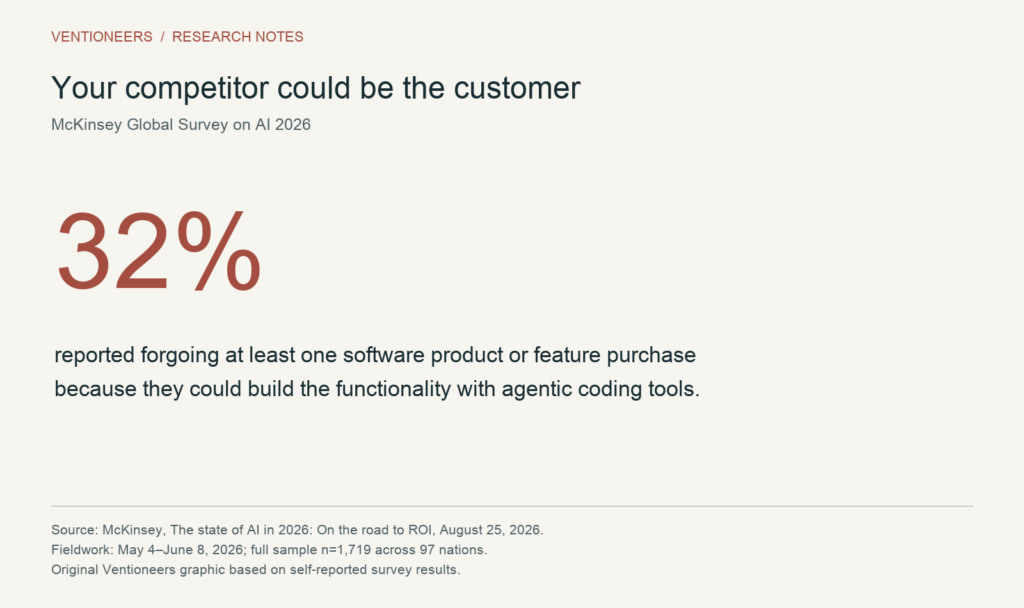
Figure 5. 32 percent reported forgoing at least one software product or feature purchase in favour of building internally with agentic coding tools. Original Ventioneers graphic based on McKinsey 2026. Published August 25, 2026; fieldwork May 4–June 8, 2026.
So the central diligence question is what happens when a customer compares the product with three alternatives: a better general model, a feature bundled into software they already pay for, or an internal build.
A benchmark win matters only if it changes a buying decision. A product that is somewhat better can still lose to one that is already integrated, trusted and included in an existing contract.
Where value accrues across the stack
The wrapper debate is about one layer: applications. We invest across the stack, and the same question, who captures the value, has a different answer at each layer.
| Layer | Where value can stick | Main risk |
| Models | Scale, research talent, distribution through APIs and products | Enormous capital needs; fast price competition between labs |
| Infrastructure (chips, compute, power, interconnect) | Physical scarcity: hardware, energized sites, supply allocations | Capital intensity, hardware obsolescence, customer concentration |
| Applications | Workflow ownership, distribution, data and outcomes (the five answers above) | Substitution by better models, incumbents or internal builds |
Better and cheaper models can improve application economics while also intensifying competition. Their effect on infrastructure demand depends on usage growth, efficiency and available capacity. Scarcity can support pricing power, but the durability of that position requires its own diligence.
We do not think one layer always wins. We do think a portfolio should know which kind of advantage it is betting on in each company, and why that advantage survives the next model release.
Price is part of the moat analysis
A good company at the wrong price can still be a bad investment. The weaker the moat, the more the entry price matters.
Consider the same AI company raising at two valuations. You put in $1 million, and assume the stake is diluted by half through later rounds before an exit.
| Entry valuation (post-money) | Ownership at entry | Ownership at exit (after 50% dilution) | Exit value needed to return 10x ($10M) |
| $40M | 2.5% | 1.25% | $800M |
| $100M | 1.0% | 0.5% | $2B |
Illustrative example with simplified assumptions; not a specific company.
At $40 million, a strong outcome needs a company worth $800 million. At $100 million, the same return needs a $2 billion company. That second outcome requires a moat that holds up against better models, incumbents and internal builds for years. If the evidence for that moat is thin, the price should be too.
How we put it together
The table below is the evidence you should look for. It is a lens for judgment, not a scoring formula.
| Question | Evidence we examine | What raises concern |
| What does the company own? | Architecture, IP, data rights, integrations, customer relationships | The differentiation is already available from the model provider |
| Why do customers buy and stay? | Independent customer calls, renewals, expansion, churn, lost deals | Demand depends on pilots, discounts or the founder’s relationships |
| Does the advantage compound? | Reusable integrations, verified learning, cheaper implementation over time | Every deployment needs heavy custom engineering |
| Do the economics hold? | Margins after inference, human review, implementation, support and exceptions | Reported software margins leave out significant delivery labor |
| Can it survive substitution? | Task level comparisons with general models, incumbents and internal builds | A cheaper or bundled alternative is good enough |
| Is the price right for the evidence? | Valuation, capital needs, dilution, milestones, realistic outcomes | The price assumes lasting leadership before it is demonstrated |
Customer evidence carries the most weight. You should try to speak with both the owner and the daily users, and ask what they would do if the product disappeared. Management supplied references help, but you should weigh them alongside renewals and lost accounts.
On the financials, separate recurring product revenue from implementation fees, pilots and services. And check whether delivery gets more efficient as the company grows, or just needs more people.
What this means for founders
The strongest fundraising story is precise about what is proven and what is still to be built.
“We have customer data” needs the rights, the distinctiveness and the measured improvement behind it. “We own the workflow” needs recurring use and customer outcomes. “We can switch models” needs a tested answer on quality, cost and migration effort.
Bring cohort data, fully loaded delivery costs, honest comparisons with alternatives and a clear list of platform dependencies. Open risks are normal at the early stage. Being clear about them makes you easier to back.
What this means for LPs
A useful product can still be a hard venture investment. Customers can get real value while competition caps what the supplier can charge. Revenue can grow alongside weak retention, expensive implementation or dependence on another company’s platform.
So decisions are never just whether the technology works. It is whether to invest, at what price, with which open questions, and against which milestones.
The evidence of discipline is not how many AI companies to review. It is how diligence changes where the capital goes, and whether you can name what would strengthen a thesis and what would break it.
The strongest advantages reinforce each other
A focused workflow produces outcome data. Permitted data improves reliability. Better outcomes earn references. References make distribution cheaper. Each link needs evidence, because none of them happens automatically.
Five questions founders should expect before their next raise
What can customers achieve with your product that they cannot reasonably achieve with the alternatives, counting implementation effort and total cost?
Which advantage gets stronger with each deployment, and what is the evidence?
What are your margins after everything it takes to deliver an acceptable result: inference, implementation, human review, support and exceptions?
What happens if your model provider or the customer’s existing vendor ships a similar feature?
What will this round prove about durability that today’s revenue does not?
Revenue earns attention. Lasting customer value earns renewals. Venture returns also need a price that lets investors share in that value. The question we keep asking is simple: does serving customers today make this company harder to replace tomorrow?
Source notes
McKinsey The state of AI in 2026 On the road to ROI, published August 25, 2026. Fieldwork May 4 to June 8, 2026; 1,719 respondents in 97 countries. Figures referenced directly to McKinsey.
Deloitte State of AI in the Enterprise 2026, published January 21, 2026. Fieldwork August to September 2025; 3,235 leaders in 24 countries.