


Investing in startups can be incredibly rewarding, but it’s also risky. Most startups fail, and money invested in private companies is usually locked up for years with no easy way to sell. That’s why many countries have rules that limit who can invest in private deals, to protect people from making investments that could put them in a very difficult financial position if they lost most or all of their capital.
In the United States, these investors are called accredited investors. Other countries use similar concepts with different names, such as accredited investors in Canada and high net worth or sophisticated investors in the UK. Here’s how to qualify, what it lets you invest in, and what to know before you start.
Why accredited investor status matters
Most startup fundraises, venture funds and syndicates raise money under exemptions from full securities registration. In the US, the most common is Regulation D, which generally limits these offerings to accredited investors. Being accredited is what gets you access to these deals.
The idea is that people who meet certain wealth, income or knowledge thresholds can better evaluate risky investments and absorb potential losses.
How to qualify in the United States
Under the SEC’s definition, you’re an accredited investor as an individual if you meet any one of the following:
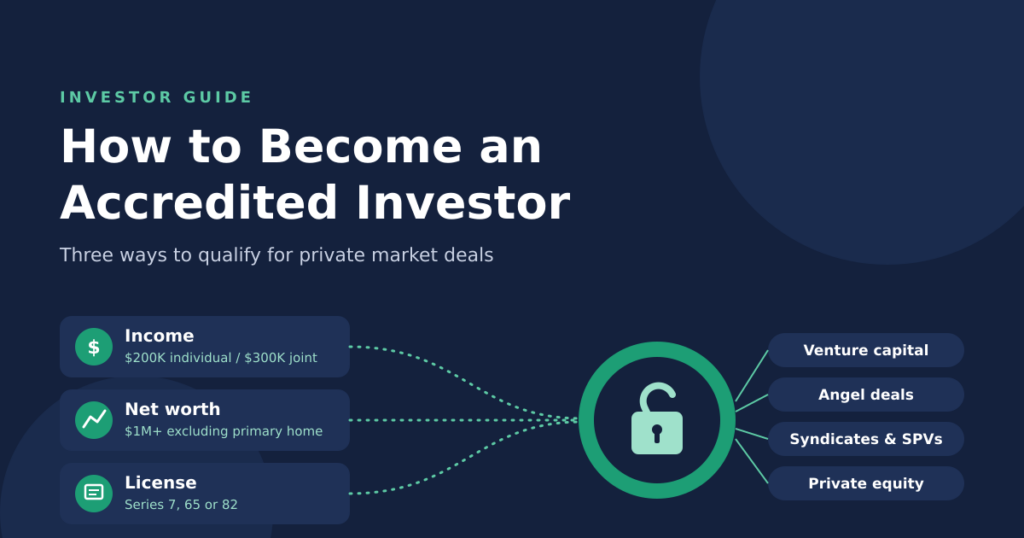
1. Income
- Individual income above $200,000 in each of the past two years, with a reasonable expectation of the same this year, or
- Joint income with a spouse or spousal equivalent above $300,000 combined in each of the past two years, with the same expectation.
Each year must meet the same test. You can’t count individual income for one year and joint income for the other.
2. Net worth
- Net worth above $1 million, alone or with a spouse or spousal equivalent, excluding your primary residence.
The value of your home doesn’t count. A mortgage on it generally doesn’t count against you either, as long as the home is worth more than the mortgage (with some exceptions for debt taken on in the 60 days before you invest).
3. Professional licenses
- You hold a Series 7, Series 65 or Series 82 license in good standing.
This path, added by the SEC in 2020, lets people qualify based on financial knowledge rather than wealth.
Insider tip: the Series 65 is usually the easier route. Unlike the Series 7, it doesn’t require sponsorship by a FINRA member firm, and it’s a shorter and cheaper exam. One caution: licenses can lapse if you’re not registered with a firm or state, so confirm your license stays in good standing for accreditation purposes.
4. Knowledgeable employees
Certain employees of a private fund, such as executives or people directly involved in its investment activities for at least 12 months, can invest in that specific fund even if they don’t meet the income or net worth tests.
Investing through an entity
Companies, trusts, LLCs and family offices can also qualify, generally if they have more than $5 million in assets or investments (and weren’t formed just to make the investment), or if every owner is an accredited investor.
Changes on the horizon
Congress is considering expanding who qualifies. The INVEST Act, which passed the House in December 2025, would create an SEC administered exam as a path to accredited status, adjust the wealth thresholds for inflation, and add criteria based on education or professional experience. As of late 2026 it has not passed the Senate and is not law. A separate bill would let people who receive personalized advice from a registered investment adviser or broker dealer qualify. Until any of these become law, the tests above apply.
Other countries
- Canada: You’re generally an accredited investor if you have pre-tax income of at least $200,000 (or $300,000 combined with a spouse) in each of the past two years, at least $1 million in financial assets (cash and securities, not real estate), or at least $5 million in net assets including your home.
- United Kingdom: Investors can self certify as high net worth (income of at least £100,000 or net assets of at least £250,000) or as sophisticated (for example, having made two or more investments in an unlisted company in the past two years). These thresholds were briefly raised in early 2024, then reversed.
- Elsewhere: Many jurisdictions, including the EU, Singapore, the UAE and Saudi Arabia, have their own professional, qualified or sophisticated investor categories with different thresholds. Check the rules where you live, and where the company or fund is based.
What you can invest in once you’re accredited
- Venture capital funds
- Angel investing in startups
- Syndicates and special purpose vehicles (SPVs)
- Private equity funds
- Hedge funds
- Private real estate funds and private credit
- Secondary shares in late stage private companies
How verification works
How you prove your status depends on how the offering is run:
- Rule 506(b) offerings can’t be publicly advertised. Investors can generally self certify, typically through a questionnaire, and the company or fund must have a reasonable belief that you qualify.
- Rule 506(c) offerings can be publicly advertised, but the issuer must take reasonable steps to verify your status. That usually means reviewing tax returns or bank and brokerage statements, or a written confirmation from your CPA, attorney or registered investment adviser.
Platforms such as AngelList run their own KYC and accreditation checks before you can invest. A verification letter from a CPA or attorney, or one from a third party verification service, can often be reused across platforms and deals for a period of time (commonly 90 days), which saves you repeating the process.
Not accredited yet? You still have options
- Equity crowdfunding (Regulation Crowdfunding): Platforms let non-accredited investors back startups, within annual investment limits based on income and net worth.
- Regulation A+ offerings: Some companies raise from the public under Reg A+, with investment limits for non-accredited investors.
- Get licensed: The Series 65 can make you accredited without meeting the wealth tests.
- Learn first: Join angel groups or communities as an observer to build your knowledge before you invest.
Before you invest
Even once you qualify, invest only money you can afford to lose and keep for many years as illiquid. Spread your investments across many companies rather than a few, over a length of time, to build diversification, because a small number of winners usually drive returns. Read the documents carefully, and understand the fees and terms of any fund or syndicate.
This article is for general information only and isn’t legal, tax or investment advice. Rules change and vary by jurisdiction, so confirm your status with a qualified professional.