


Once you’ve raised money, the relationship with your investors is just getting started. One of the simplest, most powerful habits a founder can build is sending regular investor updates: short, consistent emails that tell investors how the business is doing, what you’re focused on and where they can help.
We read a lot of investor updates at Ventioneers. The best ones are brief, honest and consistent, and they make it easy for us to help. Here’s what to include, how often to send them, and the practices that separate great updates from average ones.
Why investor updates matter
- They build trust. Investors who hear from you regularly, including when things are hard, trust you more. Silence makes investors assume the worst.
- They unlock help. Your investors have networks, customers, candidates and experience. A specific ask in an update is the easiest way to put that to work.
- They make your next raise easier. Existing investors are often your first source of follow on capital and introductions. Investors who have watched you hit milestones month after month are far more likely to back you again, and to vouch for you to new investors.
- They keep you disciplined. Writing down your metrics, wins and challenges every month forces clarity about what’s working and what isn’t.
- They warm up future investors. Adding prospective investors to your update list lets them watch your progress before your next round.
How often to send them
| Stage | Recommended frequency | Why |
|---|---|---|
| Pre-seed and seed | Monthly or quarterly | Monthly at this stage is ideal. Things change quickly, and frequent updates build momentum and trust. |
| Series A and beyond | Monthly or quarterly | Quarterly works best once you have a board and formal reporting, but many strong founders stay monthly. |
| Board members | Monthly or before each board meeting | Board members need more detail and context than the wider investor list. |
| Prospective investors | Quarterly, or a lighter version of your monthly update | Keeps them warm without oversharing. |
Whatever you choose, consistency matters more than frequency. A short update that arrives on the same day every month beats a long one that shows up whenever you remember. Pick a schedule, such as the first week of each month, and stick to it, including in bad months.
What a great investor update contains
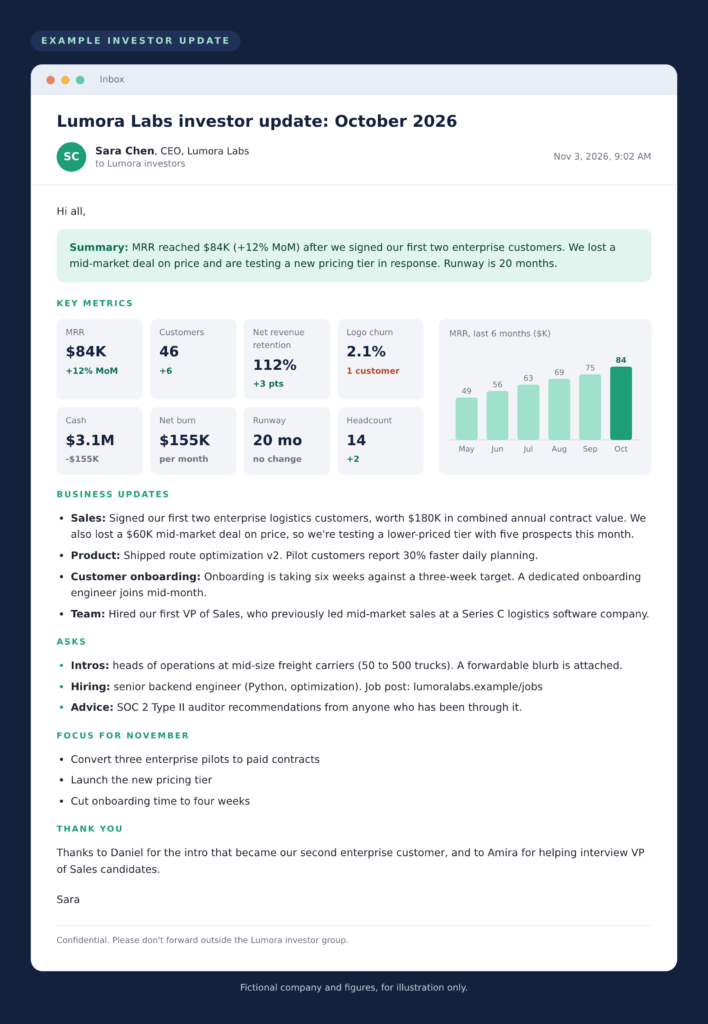
Keep the same structure every time, so investors can compare month to month and find what they need quickly. It doesn’t need to look like the above with graphics, but the main content is what is key. Great investor updates should include:
1. TL;DR
Two or three sentences at the top that summarize the month/quarter. Many investors read only this, so make it count: your headline metric, your biggest win and your biggest challenge.
2. Key metrics
The same five to eight KPIs every update, with the change from last month. Typical metrics include:
- Revenue (MRR or ARR) and growth rate
- Customers or active users
- Retention or churn
- Pipeline or bookings
- Gross margin
- Cash in the bank, monthly net burn and runway in months
- Headcount
Show the trend, not just the number: “MRR $84K (+12% MoM)” says much more than “MRR $84K.” Keep your definitions consistent, and if you change how you measure something, say so.
Deep tech founders should add progress against technical milestones, such as prototype results, test data, IP filings, certifications, pilot status, growing LOIs, and grants.
3. Business Updates (Highlights, Lowlights)
Your wins this month: new customers, product launches, key hires, partnerships, press, technical breakthroughs. Keep each to a line or two.
What didn’t go well: a lost deal, a delayed launch, a missed target, a key departure. Explain what happened and what you’re doing about it. This is the section most founders want to skip, and it’s the one that builds the most trust.
5. Asks
The most valuable section for you. Be specific about what you need:
- “Intro to the VP of Operations at [Company]”
- “Looking for a senior backend engineer with [skill]; please share our job post”
- “Advice from anyone who has negotiated a contract with [type of customer]”
- “Intro to potential leads for our upcoming Series A.”
Vague asks like “Let us know if you can help with sales” rarely get a response. Two or three specific asks get far more.
6. Focus for next month
Your top two or three priorities for the coming month. This sets expectations and gives you something to report against next time.
7. Thank yous
Thank investors who helped since the last update, by name. It shows that help is noticed and encourages more of it.
Optional sections
- Product updates: screenshots or a short demo link
- Team: new hires and open roles
- Fundraising: if you’re planning a raise, give investors a heads up on timing and terms before you go out
- Customer story: a quote or short case study that shows the impact of your product
Best practices
Keep it short. Aim for something that can be read in two to three minutes. Use headers and bullets, and link to more detail rather than pasting it in.
Be honest, especially when things are hard. Investors know startups are difficult. What erodes trust is surprises. If cash is getting tight or a key metric is falling, say so early, while investors still have time to help. Never let investors learn bad news from someone else.
Lead with numbers, then the story. Metrics first, then the narrative explaining them.
Use the same format every time. Consistency makes updates fast to write and easy to read, and it makes trends obvious.
Don’t only send updates when you need money. Founders who go quiet and reappear when they’re raising are easy to spot. Regular updates mean your investors already know your story when it’s time to raise.
Make asks easy to act on. Include the name of the person you want to meet, a short blurb an investor can forward, or a direct link to your job post.
Protect confidential information. Updates get forwarded. Leave out anything you wouldn’t want a competitor to see, and consider marking the email confidential.
Follow up on help. When an investor makes an intro, close the loop and tell them what happened. It encourages them to keep helping.
Use simple tools. A plain email works well. Investor update tools (such as Visible), a shared doc, or your email platform can also make it easier to track metrics and manage your list.
Keep a separate board update. Board members need deeper financials, detailed plans and decisions to make. Don’t overload your wider investor list with that detail.
Common mistakes
- Sending updates only when things are going well
- Changing which metrics you report from month to month
- Long, unstructured emails with no clear takeaways
- No asks, or asks too vague to act on
- Hiding bad news until it becomes a crisis
- Burying your runway or cash position
- Letting updates lapse after the round closes
A simple template
Subject: [Company] investor update: [Month Year]
Hi all,
TL;DR: [Headline metric and biggest win.] [Biggest challenge.]
Key metrics
- MRR: $[X] ([+/-X]% MoM)
- Customers / active users: [X] ([+/-X])
- Churn: [X]%
- Cash: $[X] | Burn: $[X]/month | Runway: [X] months
Business Updates
- [Highlight: Win]
- [Lowlight: Challenge and what we’re doing about it]
Asks
- [Specific intro or help needed]
- [Hiring: role and link]
Focus for next month
- [Priority 1]
- [Priority 2]
Thank you to [Name] for [help].
[Your name]
The bottom line
Investor updates take an hour or two a month and pay off for years. They build trust, turn your investors into an active resource, and set you up for your next raise. Start with your next month’s numbers, use the template above, and send it on the same day every month, in good months and bad.